

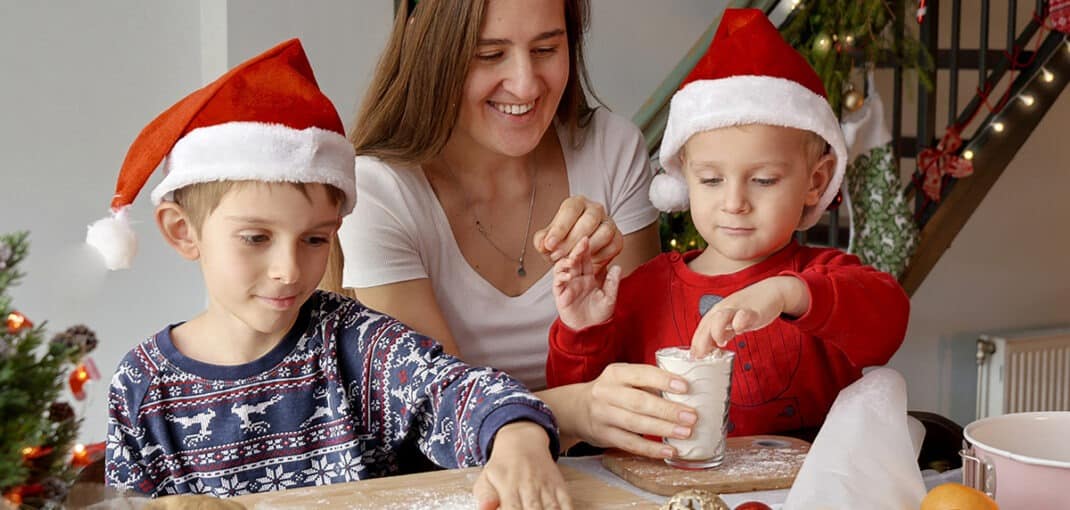
Cooking with children over the holidays is mostly an exercise in lowering your standards about mess and raising them about what a child can actually manage. Given a real job rather than a token one, most kids rise to it.
What Children Can Actually Do, by Age
The trick is matching the job to the hands. Too easy and they wander off; too hard and you end up doing it yourself while they watch.
- Two to three. Washing vegetables, tearing herbs and lettuce, stirring something cold, pressing cookie cutters, putting things in bowls.
- Four to five. Measuring and pouring, whisking, greasing a tin, threading skewers, brushing glaze onto a ham. Anything with a pastry brush is usually a hit.
- Six to eight. Peeling with a vegetable peeler, cracking eggs, kneading dough, cutting soft things with a table knife, shaping meatballs.
- Nine to twelve. Reading a recipe through before starting, using a sharp knife with you next to them, working at the stove with supervision, taking temperatures with a thermometer.
Give Them the Thermometer
This is the single best job to hand over. It is genuinely useful, it is impossible to do badly, and it teaches the habit that keeps people from serving undercooked meat for the rest of their lives. Show them where to put the probe, the thickest part and away from the bone, and let them call it.
- Poultry: 165°F.
- Ground meat: 160°F.
- Whole cuts of beef, pork and lamb: 145°F, then rested.
Our turkey guide goes through the timing in more detail if the bird is the centerpiece.
Five Things Worth Making Together
Each of these gives a child a real job rather than a token one, and none of them falls apart if that job is done imperfectly. Temperatures are the ones from the section above, so whoever is holding the thermometer already knows the number they are looking for.
- A snack board. The one with no cooking in it, which makes it the job for the youngest hands. Give them a board and let them lay out cured meats, cheeses, olives, grapes, nuts and crackers. Folding salami into quarters and rolling prosciutto are both genuinely easier for small fingers than for yours. We cut the meats and cheeses to order at the counter, so you can buy the exact amount you need rather than three packets you will not finish.
- Meatball skewers. Rolling meatballs is the perfect small-hands job, and threading them onto skewers keeps them busy afterwards. Season the mix yourself, then let them roll golf-ball portions and thread three or four per skewer with a bay leaf or a folded sage leaf between them. Roast at 400°F, turning once, until the middles read 160°F, which is the ground-meat number. Ask us for a ground beef and pork mix if you want them to stay tender.
- A glazed ham. The scoring is yours, the glazing is theirs. Score the fat in a diamond pattern, then hand over a brush and a bowl of glaze and let them paint it every twenty minutes. It gives them a reason to keep coming back to the oven, and the ham is already cooked, so you are warming it through to about 140°F rather than cooking it. Brown sugar, mustard and whatever fruit preserve is open makes a glaze without a recipe.
- Sausage rolls or hand pies. Rolling, filling, crimping the edges with a fork. Everything about it is child-shaped work. Lay a rope of sausage meat along a strip of pastry, fold, seal with a fork, brush with egg and cut into lengths. Bake at 400°F until the pastry is deep gold and the filling reads 160°F. Our sausages come out of the case in whatever quantity you need, and we will take them out of the casing for you so nobody has to fight one at home.
- Stuffed pork tenderloin. For older children, and the one that feels like real butchery, because it is. They can lay out the filling along a butterflied tenderloin and help tie it at even intervals. Sear it, then finish in the oven to 145°F and rest it for three minutes before slicing. Ask us to butterfly it when you buy it and the hardest part is already done.
If you want a cut prepared a particular way to make it easier, ask us. Butterflying a tenderloin or tying a roast is an ordinary custom cut and takes us a minute.
The Rules Worth Keeping
- Hands washed before, after, and every time raw meat is touched.
- One board for raw meat, a different one for everything else. Say it out loud every time and it sticks.
- Nobody tastes a raw mixture, however much they want to.
- The oven and hot pans are yours. That line is easier to hold if you have given them enough else to do. There is more on handling in our guide to storing meat properly.
Let Them Choose Something
Bring them to the counter and let them pick. Children who have chosen the meat are noticeably more interested in eating it later, and our butchers are used to being asked what something is. It is a better education than any amount of watching cookery on a screen.
We are at 2030 Main Street NW in Riverside, and our hours are on the contact page. Come in and let them ask.